

Perfectionism, Anxiety, and Procrastination: Understanding the Cycle and How Therapy Can Help
WRITTEN BY: Ara Cho, PsyD
Do you spend hours overthinking decisions, putting off important tasks, or feeling like nothing you do is ever quite good enough?
Or maybe you sit down intending to complete one task, only to find yourself thinking about everything else that also needs to get done. Suddenly, responding to one email reminds you of unfinished work projects, household responsibilities, appointments, and countless other obligations. Before you know it, the entire list feels overwhelming, and getting started on any one thing feels nearly impossible.
If so, you may be caught in a common cycle involving perfectionism, anxiety, and procrastination.
Many people assume procrastination means they're lazy or lacking motivation. In reality, procrastination is often connected to anxiety. When the pressure to perform, succeed, avoid mistakes, or keep up with everything on your plate becomes overwhelming, it can feel nearly impossible to get started.
As a therapist, I often work with individuals struggling with perfectionism, chronic self-criticism, anxiety, and procrastination. While these experiences can feel frustrating and isolating, they are often deeply connected, and they can be understood with compassion rather than judgment.
The Connection Between Perfectionism and Anxiety
Perfectionism and anxiety often go hand in hand.
When you feel like you need to do something perfectly, every task can start to feel high stakes. Sending an email, applying for a job, completing a work project, making a decision, or even responding to a text message can suddenly feel loaded with pressure.
You may find yourself thinking:
"What if I make a mistake?"
"What if people judge me?"
"What if it's not good enough?"
"I should be able to do this better."
For some people, the pressure isn't only about doing one thing perfectly. It's also about trying to keep up with everything. The moment they begin one task, their mind races to everything else that still needs attention. Instead of focusing on one next step, they feel the weight of the entire to-do list all at once.
The higher the expectations become, the more anxiety tends to increase.
For many people, perfectionism is not simply about wanting things to be excellent. It's often driven by fears of criticism, rejection, failure, disappointing others, forgetting something important, making the wrong choice, or not feeling good enough.
Why Perfectionism Often Leads to Procrastination
One of the biggest misconceptions about procrastination is that it happens because people don't care.
In reality, many people procrastinate because they care deeply.
When a task feels tied to self-worth, performance, or fear of failure, it can become emotionally overwhelming. The nervous system responds to that pressure much like it responds to other forms of stress: by wanting to escape it.
Sometimes the overwhelm isn't just about the task itself. Beginning one task can trigger thoughts about everything else that also needs your attention. Rather than feeling like you're completing one small step, it can feel as though you're facing dozens of demands all at once. When everything feels equally urgent or important, deciding where to begin can become surprisingly difficult.
This is why you may find yourself:
Avoiding getting started
Constantly researching or preparing
Waiting until you "feel ready"
Getting distracted by lower-priority tasks
Feeling overwhelmed by everything that needs to get done
Not knowing where to begin
Putting things off until the last minute
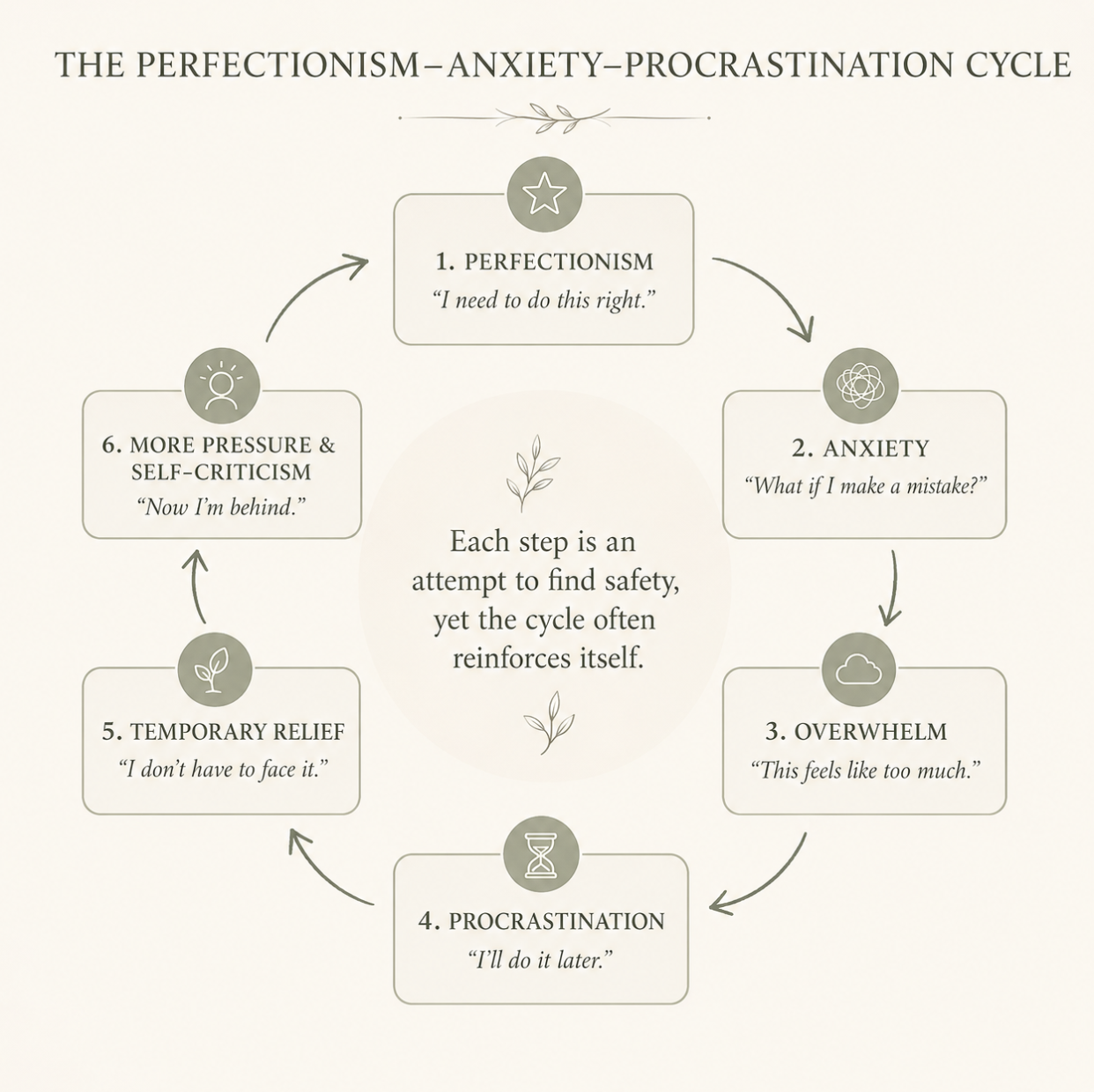
Procrastination often provides temporary relief from anxiety, reinforcing the behavior and making it easy to get stuck in the cycle.
Unfortunately, the relief doesn't last.
The task remains unfinished, deadlines get closer, anxiety increases, and self-criticism becomes louder. As anxiety grows, the desire to do things perfectly often grows as well. The unfinished tasks may also continue accumulating, making it feel even harder to know where to start.
This creates a cycle of perfectionism, anxiety, and procrastination that can feel incredibly difficult to break.
Understanding Perfectionism, Anxiety, and Procrastination Through an IFS Lens
One way to understand this cycle is through Internal Family Systems (IFS) therapy.
IFS suggests that we all have different parts of ourselves with different concerns, emotions, and strategies.
For example, there may be:
A perfectionistic part that pushes you to do everything flawlessly
An anxious part that worries about what could go wrong
A critical inner voice that constantly points out mistakes
An overwhelmed part that feels responsible for everything at once
An avoidant part that wants to step away when things feel overwhelming
At first, these parts can seem like they're working against each other, which can feel chaotic or frustrating.
One part pushes.
One part worries.
One part criticizes.
One part reminds you of everything you still have to do.
One part avoids.
But underneath these different reactions is often a shared goal: protection.
The perfectionistic part may be trying to protect you from failure, rejection, criticism, or shame.
The anxious part may be trying to keep you prepared and safe.
The overwhelmed part may believe that constantly scanning everything that needs your attention will help you stay on top of your responsibilities.
The avoidant part may be trying to protect you from feeling overwhelmed.
Even the inner critic may believe that harsh self-pressure is necessary to prevent mistakes or disappointment.
When we begin to understand these parts with curiosity rather than judgment, we often discover that they are not the problem. They are protective strategies that developed for understandable reasons.

What Does Therapy for Perfectionism, Anxiety, and Procrastination Look Like?
Many people seek therapy because they want to stop procrastinating, reduce anxiety, or quiet their inner critic.
In IFS therapy, we often begin by understanding these experiences rather than fighting them.
Together, we explore questions such as:
What is the perfectionistic part afraid would happen if you weren't perfect?
What is the inner critic trying to accomplish?
What emotions arise when you try to start a task?
What happens inside when everything feels urgent at once?
What does the avoidant part need when it feels overwhelmed?
As therapy progresses, people often develop a more compassionate and balanced relationship with themselves.
Rather than being driven by fear, pressure, or self-criticism, they begin to develop greater self-trust, flexibility, and confidence. Many also find it becomes easier to focus on one step at a time, rather than feeling consumed by everything that needs to get done.
The goal isn't to eliminate ambition, motivation, or high standards. The goal is to reduce the fear and anxiety that often become attached to them.

Therapy for Perfectionism and Anxiety in California
If you're struggling with perfectionism, anxiety, procrastination, self-criticism, overwhelm, or fear of failure, therapy can help you better understand the patterns keeping you stuck.
Whether these challenges affect your work, relationships, academic performance, or overall well-being, you don't have to navigate them alone.
We work with adults experiencing anxiety, perfectionism, burnout, overwhelm, and chronic self-pressure, helping clients better understand themselves, build self-compassion, and create lasting change.
If this article resonates with you, contact us to take a meaningful step towards healing.
Please note: The views expressed in this article are those of the author and may or may not necessarily represent the perspectives of our group practice.